
The tried-and-true strategies for winning capital equipment sales have started to show their age. Even if you know the stakeholders, the clinical value, and how to run a sales process, deals may not come as easily as they used to. Opportunities stall. Evaluations don’t materialize. Contracts renew with existing vendors despite strong alternatives.
The issue isn’t the sales team’s engagement, effort, or visibility. It’s that the capital purchase decision-making process inside health systems has undergone a fundamental shift. A new set of proven tactics can help MedTech sales teams find their footing in the new landscape.
Capital Sales Are Not Continuous, They’re Cyclical
There are a finite number of buyers in capital equipment. For most categories, the U.S. market is limited to a defined set of hospitals and health systems. This presents MedTech companies with a fixed set of opportunities, and winning within them is the key to near-term growth.
Those opportunities are governed by contract cycles and capital allocation processes. A health system may not evaluate a category for several years. If a contract was recently signed, the likelihood of near-term reconsideration is low, regardless of product quality or sales effort, creating a fundamental constraint.
Effective capital sales strategies are not about generating demand in the moment. They’re about aligning to when demand becomes available.
Hospital Purchasing Decisions Are Made by Groups, Not Individuals
Inside health systems, purchasing decisions are not driven by a single stakeholder. They’re most often made through structured committees, most commonly the Value Analysis Committee (VAC). These committees bring together four primary perspectives: Clinical, Financial, Operational, and Technology.
Each group evaluates capital purchases differently. Clinical stakeholders focus on patient care. Finance evaluates cost and return. Operations looks at workflow and system impact. Technology determines feasibility and integration risks, particularly if the capital integrates with the health system’s electronic medical record.
No single perspective is sufficient to move a decision forward – alignment across all of them is required. This is where many commercial strategies break down. Engagement is often concentrated on clinical stakeholders, while financial, operational, and technology perspectives are addressed late (or not at all). By the time those stakeholders are engaged, their position is often already formed. By taking a more comprehensive approach, win rates rise.
The Most Important Work Happens Before the Opportunity Exists
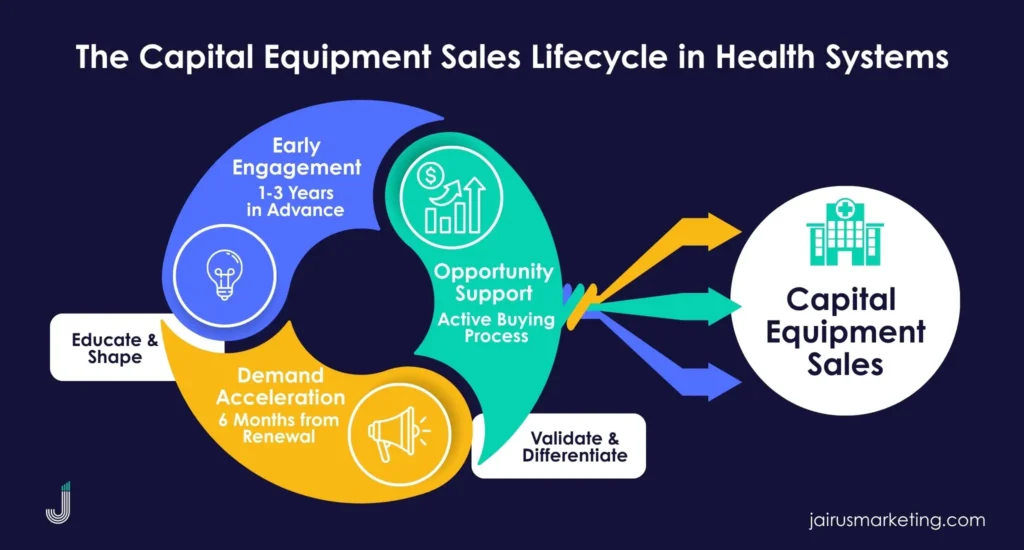
One of the most misunderstood aspects of capital sales in IDN settings is timing. By the time an RFP is issued, the decision-making framework is already established. Stakeholders have defined the problem, aligned on priorities and often developed a preference for how the evaluation should be structured. At that point, medical device companies are competing within a process, not shaping it.
The MedTech organizations that consistently win are the ones that engage with prospects earlier, using their marketing efforts to educate and influence how stakeholders think about the problem to be solved differently before a formal evaluation even begins. Successful sales teams then introduce new ways of defining value, aligning multiple personas around a shared perspective well in advance of a purchasing cycle. This isn’t a tweak to yesterday’s process. It’s a realignment to what wins deals today.
Capital Sales Require a Different Commercial System
This environment changes the role of both sales and marketing. Sales teams can’t influence decisions made behind closed doors. As a result, sales cannot be the sole voice speaking to an account. Medical device marketing must successfully engage those stakeholders who are otherwise unreachable, rather than function solely as a lead generation engine. This tandem approach ensures that all relevant decision-makers are reached well in advance of the buying window, and that their specific priorities are reflected at each stage of the sales cycle.
Winning requires coordination. Sales, marketing and supporting functions must operate as a unified system aligned to individual opportunities and long-term positioning. Efforts must extend beyond active deals to include early-stage influence and sustained engagement across the buying cycle. This is less about increasing activity and more about aligning activity to how decisions are actually made. (Not sure how to get started? Schedule a call to learn how.)
A Different Way to Approach Capital Growth
Capital equipment sales require a long-term, system-oriented approach that accounts for finite buyers, defined cycles and consensus-driven decisions. Medical device companies that recognize this shift, and build around it, position themselves differently.
They engage earlier, influence more stakeholders and align their commercial teams around the full lifecycle of an opportunity. And when the buying window opens, they are not introducing themselves – they’re already the preferred option.
Interested in evaluating how your current commercial model stacks up to that goal? Reach out for a discovery call.